Scientific Name
Bos javanicus
Status
Critically endangered
Size
Length: 250 – 350 cm
Height: 150 - 175 cm (To Shoulder)
Weight: Males: 600 - 800 Kg Females: 590 - 670 Kg
Diet
Herbivorous.
Primarily grazing on grasses, sedges, and herbs, but also browsing on leaves, shoots, fruits, flowers, and bark from trees and shrubs.
Appearance
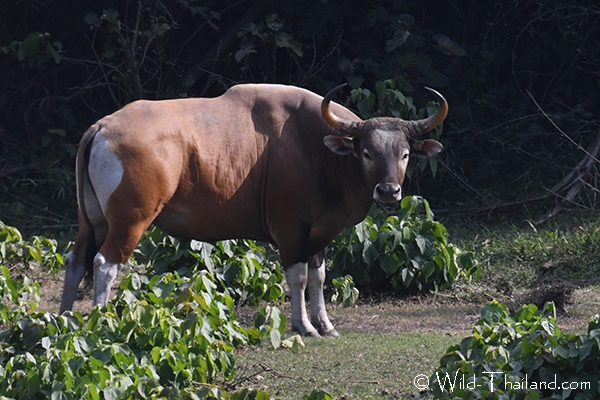
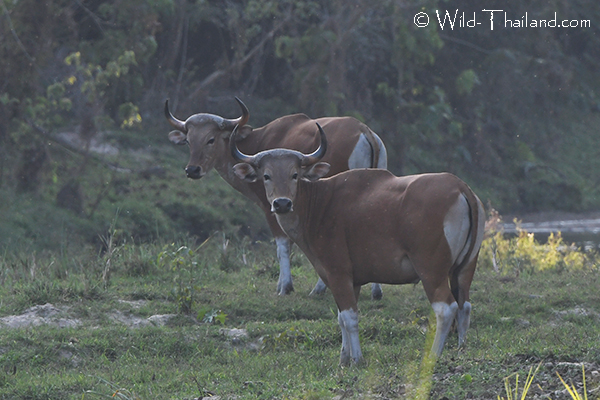
Banteng have distinct white "stockings" on their lower legs and a white patch on their rump, with males being dark brown/black and females lighter reddish-brown, both have upward-curving horns, with bulls' being much larger and more prominent.
Distribution
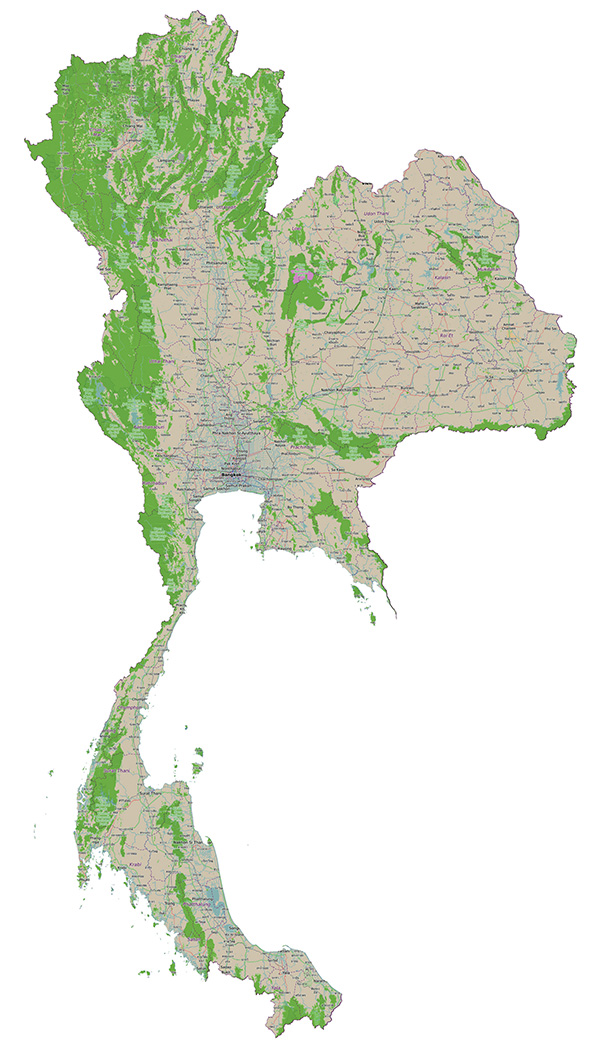
Surviving primarily in the Western Forest Complex, with the largest population in Huai Kha Khaeng Wildlife Sanctuary.
Banteng are naturally diurnal, but in areas disturbed by man, they will be more active at night.
Banteng can be seen in large groups, in the grasslands on the right side of the road just before the sanctuary entrance.
Very high success of sightings, behind the museum and at the watch tower, throughout the day, particularly in the late afternoon and early evening.
They can also be seen along the road from the museum to the restaurant and across the river at the restaurant.
Keep your distance, do not in any way attempt to block or restrict access to a Banteng that is in your immediate vicinity. Always give the Banteng plenty of space to escape.
Ignoring advice can be dangerous to you or others near to you.
Scientific Name
Bos gaurus
Status
Vulnerable
Size
Length: 250 – 330 cm
Height: 142 - 220 cm (To Shoulder)
Weight: Males: 588 - 1500 Kg Females: 440 - 1000 Kg
Diet
Herbivorous.
Grass, leaves, stems, fruit and seeds.
Appearance
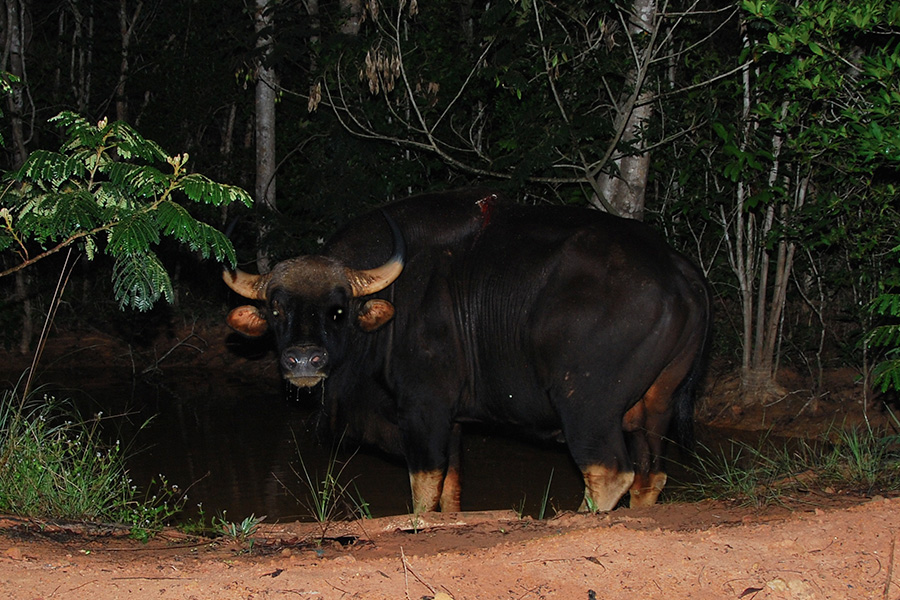
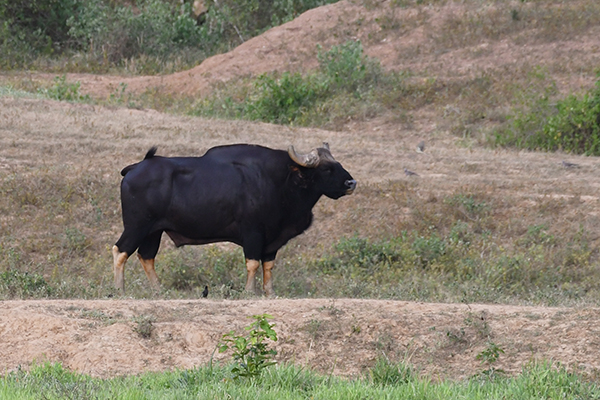
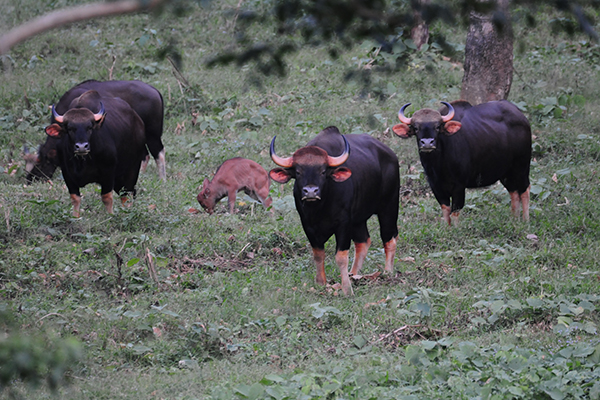
Gaur are the worlds largest wild cattle. Males are dark brown / black, females are often slightly lighter in colour. The top of the head is greyish - white, the muzzle is pale coloured and the legs are white - tan.
Distribution
Throughout Thailand as far north as Thung Salaeng Luang National Park.
Gaur are found in protected forested area and are naturally diurnal, but due to human disturbance, in Thailand they have become mostly nocturnal.
Late afternoon sightings have been increasing in Khao Yai, especially in the Khao Kheow area, where they are often seen in the late afternoon leaving the forest to feed. It is not unusual to encounter these magnificent animals on the road to Khao Kheow. If it has been raining during the day, it appears to increase the chances of seeing Gaur in the afternoon.
In the early morning, Gaur can occasionally be seen in the Khao Kheow area and the open grasslands on the other side of the lake from the Nong Phak Chi observation tower.
In the evening, after dark, Gaur can be encountered on or near the road to the Pak Chong entrance, at the Nong Phak Chi mineral licks and in the Grasslands on the west side of the road.
Gaur are sometimes seen during night safaris in the Grasslands and at the Nong Phak Chi mineral licks.
late evening along the track beyond the ranger station / campsite.
Early evening near to the water tower and along the track from the head quarters.
Although the population of Gaur in Kaeng Krachan is much larger than Khao Yai, sightings are not so common.
In areas typically not visited by people, Gaur will form large herds of over fifty individuals.
With driving restrictions in force, it is not possible to venture out of the Ban Krang camp site after dark. However, Gaur can sometimes be seen in the late afternoon and early evening, along the road from the park entrance in the area where the ponds are.
Kui Buri allows only guided vehicle tours within the park. These can be arranged at the office next to the park entrance.
Kui Buri is one of few places, where Gaur are regularly seen in during the day.
Often seen in the early and late evening, along the road from the entrance to the head quarters, near to the head quarters. They are also seen in herds around the larger lakes.
Khao Paeng Ma is for Gaur, in the late afternoon and early evening, large number of Gaur can be seen in the open grasslands in the valley below.
Gaur are very large powerful animals, capable of sudden bursts of speed. There are numerous reports of Gaur attacks in the forest, some resulting in serious injury and death.
Keep your distance, do not in any way attempt to block or restrict access to a Gaur that is in your immediate vicinity. Always give the Gaur plenty of space to escape.
Ignoring advice can be dangerous to you or others near to you.