Scientific Name
hloropsis moluccensis
Status
Near Threatened
Size
Length: 15.8 - 20 cm
Weight: 20 - 28.5 g
Diet
Fruits, nectar, and insects.
Appearance
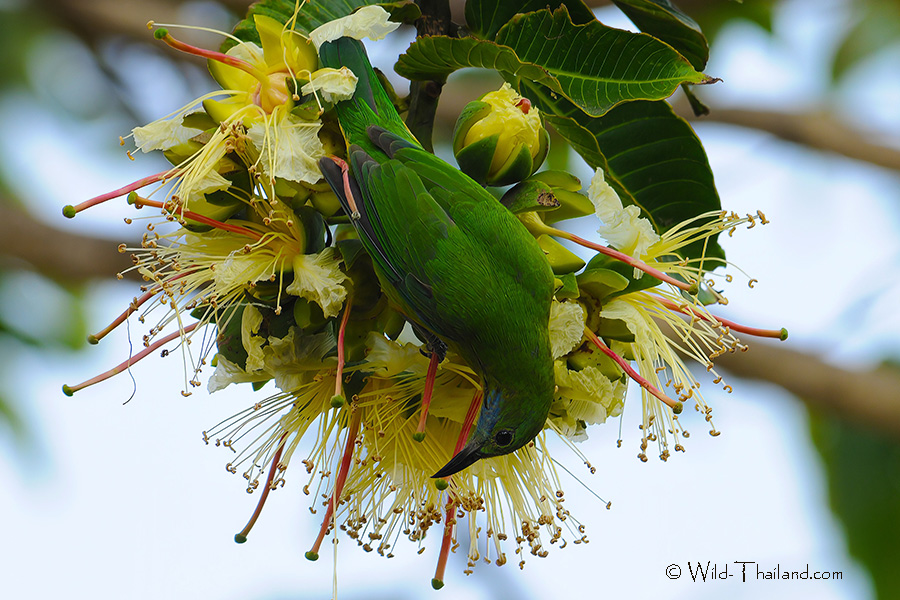
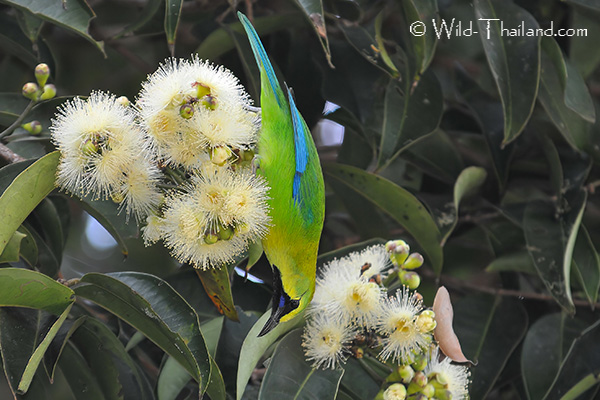
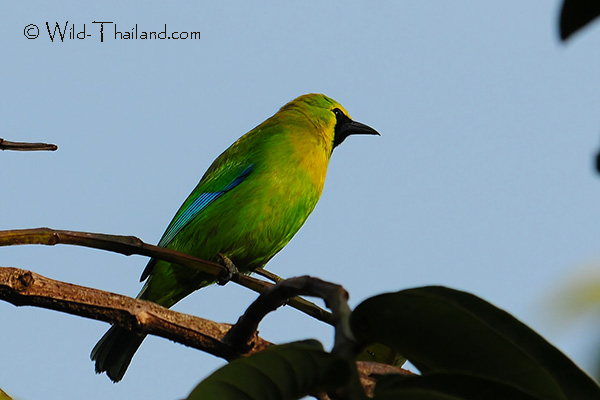
The Blue-winged Leafbird has a primarily green body with a bright turquoise-blue patch on its wings and tail. Males are further distinguished by a black face mask and throat, a blue submoustachial stripe, and varying amounts of yellow on the head and face. Females are mostly green, with a less defined blue smudge on the throat and a limited blue stripe.
Distribution
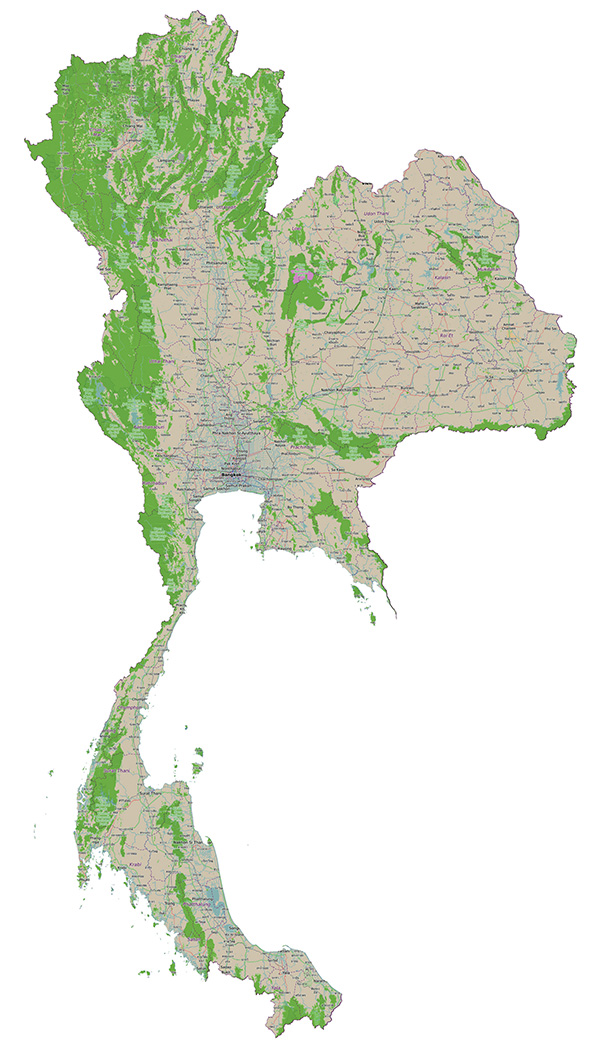
The Blue-winged Leafbird is found throughout Thailand, in dry dipterocarp forests and mixed deciduous forests, up to about 1,200 meters.
Blue-winged Leafbirds are often seen in flowering trees collecting nectar, or in fruit trees.
The breeding season for the Blue-winged Leafbird in Thailand is from April to August. They build open, cup-shaped nests on tree branches.
Scientific Name
Chloropsis aurifrons
Status
Vulnerable
Size
Length: 17 - 19 cm
Weight: 45 g
Diet
Insects, fruits, and nectar.
Appearance
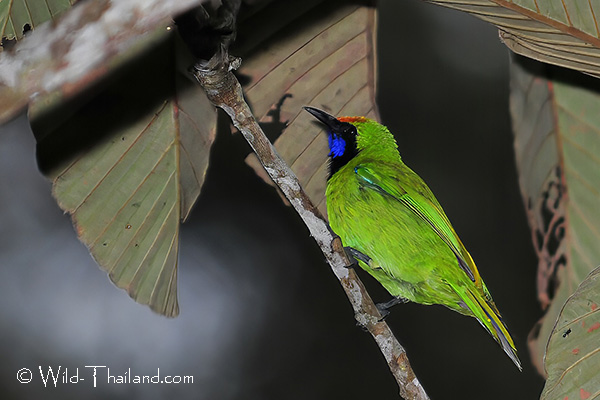
The Golden-fronted Leafbird is a green-bodied bird with a distinct golden-yellow forehead, a black face and throat bordered with yellow, and a blue moustache stripe. Adults have dark brown irises and blackish feet and bills.
Distribution
The Golden-fronted Leafbird is found throughout Thailand, particularly in the north, central, and western regions, in dry dipterocarp forests and mixed deciduous forests.
Golden-fronted Leafbirds are active foragers, spending most of their time in the forest canopy, sometimes in small groups, foraging for food.
Golden-fronted Leafbirds breed from February to July, though the exact seasonal variations are not well-known. The nest is an open cup built by both parents from fine twigs, grasses, and cobwebs.
Scientific Name
Chloropsis cyanopogon
Status
Near Threatened
Size
Length: 16 - 18 cm
Weight: 18.5 - 22.8 g,
Diet
Insects, fruits, and nectar.
Appearance
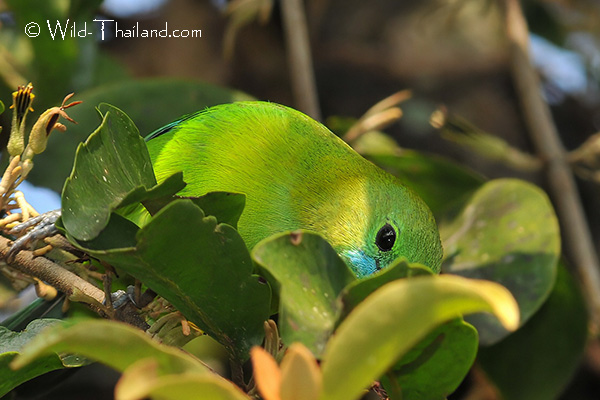
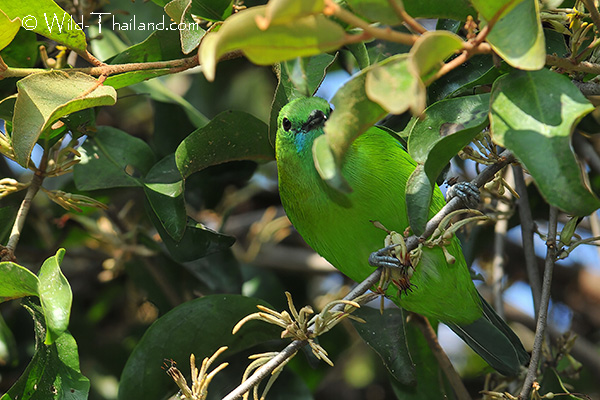
The Lesser Green Leafbird is a medium-sized bird with a bright green body, a black mask, and a cobalt-blue flash on the jawline for the male. Females are similar but lack the black mask, and both sexes have a yellow-tinged forehead.
Distribution
The Lesser Green Leafbird is found in peninsular Thailand. Preferring lowland tropical moist forest, up to 700 meters.
Lesser Green Leafbirds can be seen foraging in the canopy for food.
The Lesser Green Leafbird breeds between February and August, building cup-shaped nests from plant materials in trees.
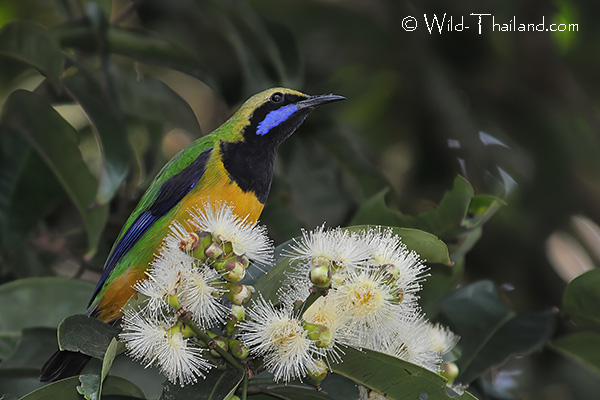
Scientific Name
Chloropsis hardwickii
Status
Vulnerable
Size
Length: 15 - 20 cm
Weight: 25 - 40 g
Diet
Insects, fruits, and nectar.
Appearance
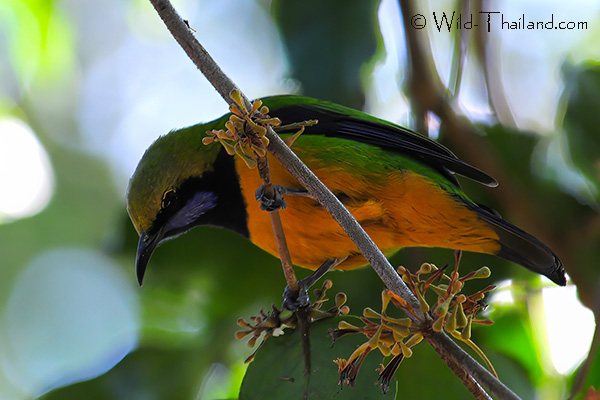
The Orange-bellied Leafbird has a distinctive bright appearance, with males having a blue and black face, a solid orange belly, and green upper parts with blue wings. Females are a more uniform green, with blue cheeks and a less extensive orange on the belly.
Distribution
The Orange-bellied Leafbird is found in western, northern, and northeastern Thailand, inhabiting hilly woodlands from lowlands up to foothills.
Orange-bellied Leafbirds are territorial and when foraging, will chase other birds away.
Orange-bellied leafbirds in Thailand breed primarily from January to April. The pair builds a shallow, open cup-shaped nest. It is constructed from fine fibrous materials, roots, and stems and is suspended like a hammock from thin twigs at the end of a tree branch, typically 6–10 meters above the ground.