Scientific Name
Anorrhinus austeni
Status
Near Threatened
Size
Length: 73 - 80 cm
Weight: 710 - 900 g
Diet
Primarily fruit but also consumes insects, bats, snakes, lizards, snails, and the eggs and chicks of other birds.
Appearance
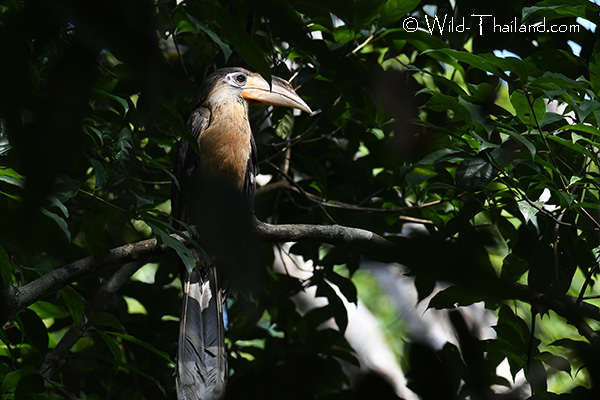
The Austen's Brown Hornbill is a medium-sized hornbill that is generally brown with a white-tipped tail. Males have distinctive white cheeks and throat, a pale creamy bill, and rufous-brown underparts, while females are darker with a darker head and throat. Both have bare blue-gray skin around the eyes and a horn (casque) on the bill.
Distribution
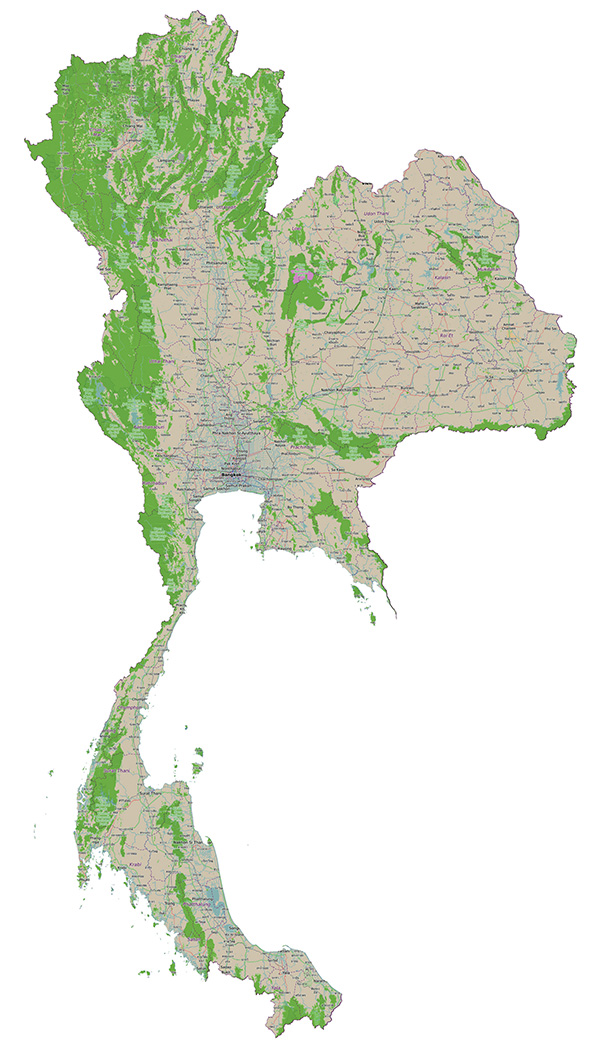
Austen's Brown Hornbills are found in northern and central Thailand, inhabiting evergreen and deciduous forests, from lowlands to hills up to 1,500 meters.
Austen's Brown hornbill live in territorial groups, foraging together in the canopy, and unique cooperative breeding where helpers assist the dominant pair. They are most commonly seen at or near nest holes.
In Khao Yai there is an established nesting area located along trail 1, that starts at the rope bridge, behind the visitor centre.
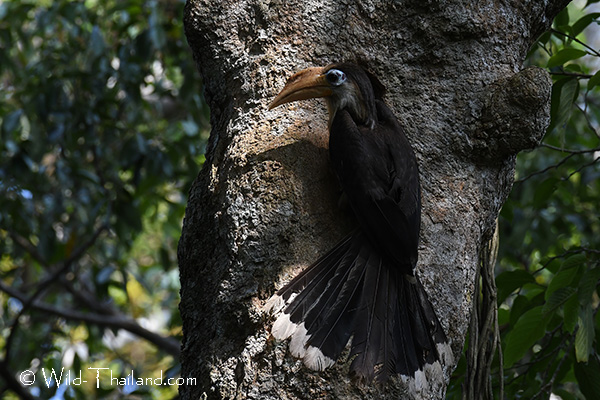
The Austen's Brown Hornbill breeding season generally begins in February and continues through May or June. The nests are made in either natural holes or old woodpecker holes. The female enters the cavity and uses her droppings, food debris, and other material to seal herself inside the cavity, leaving only a small slit.
The male, with the help of up to five younger males (often yearlings from the same family), feed the female and chicks.
Scientific Name
Buceros bicornis
Status
Vulnerable
Size
Length: 95 - 130 cm
Weight: 2 - 4 kg
Diet
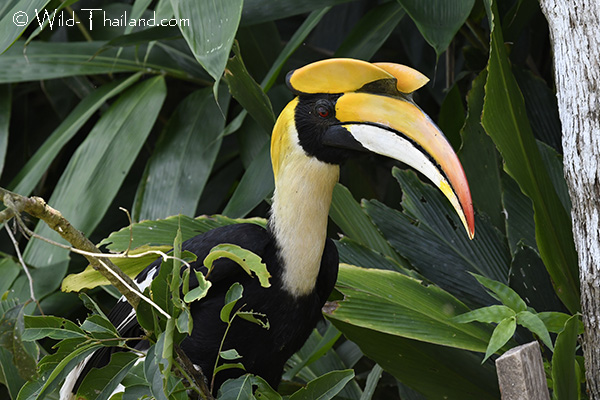
Primarily eats fruits, especially figs, but also consumes insects, small reptiles, amphibians, and small mammals.
Appearance
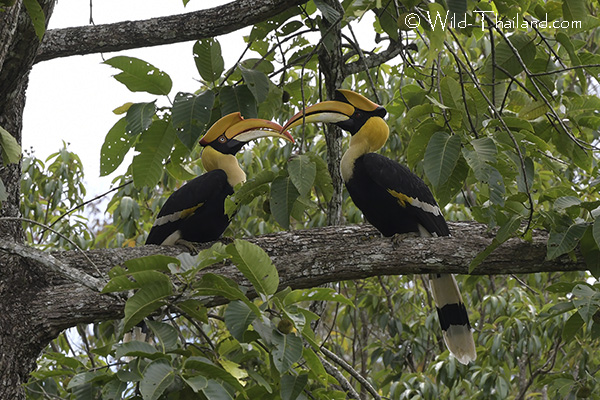
The Great hornbill is a large bird with a distinctive yellow and black casque, a prominent feature on top of its massive bill. It has black wings and breast, which contrast with its white neck, belly, and tail. Males can be identified by their red eyes, while females have bluish-white eyes.
Distribution
The Great Hornbill is found in the forests of Thailand, primarily in large, protected forest complexes in the east, west, and south of the country. They prefer dense, old-growth forests in hilly regions and are dependent on large stretches of forest.
Great Hornbills are social and territorial birds, they are often seen feeding in fig trees. They are very loud and vocal, with deep, hoarse grunts and roars.
Breeding is typically from January to June. Established mating pairs will reuse old nest holes when possible. The female will enter the cavity and both birds will help close the entrance. so that just a small slit is left.
Scientific Name
Anthracoceros albirostris
Status
Least Concern
Size
Length: 55 - 60 cm
Weight: 680 - 907 g
Diet
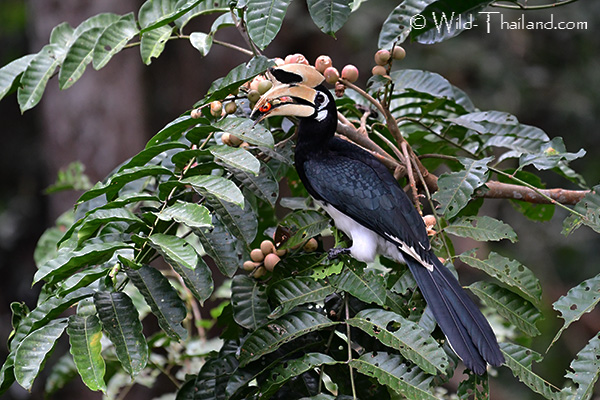
Mainly fruit, supplemented with insects, lizards, snakes, bats, and eggs.
Appearance
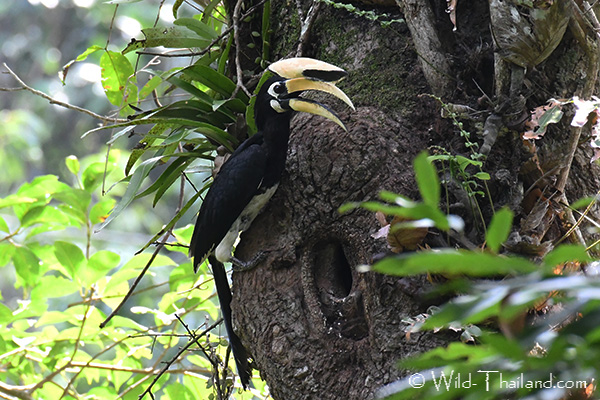
The Oriental Pied Hornbill is a medium-sized black-and-white bird with a large, yellow-and-black bill and a characteristic casque, on top of the bill. Males and females are similar in plumage but males have a larger casque and red eyes, while females have smaller casques and brown eyes. Their plumage is mostly black on the head, back, and upper breast, with white on the belly, underparts, and the tips of the wings and tail feathers.
Distribution
The Oriental Pied Hornbill is found throughout Thailand, except the upper Northeast. It prefers forest edges, secondary growth, riverine forests, and open, moist deciduous and evergreen forests, but can also be found in gardens and agricultural fields up to an elevation of approximately 700 meters.
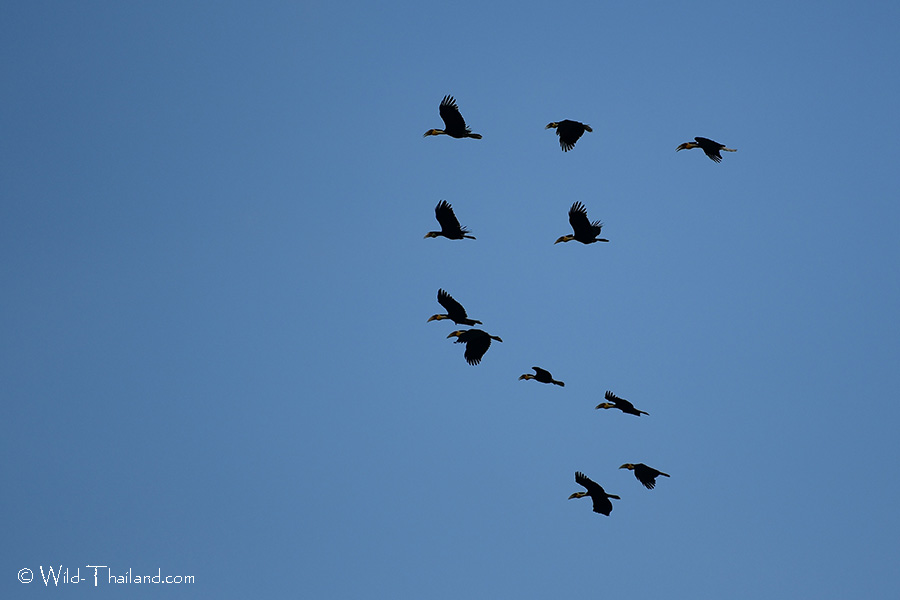
Common sight in Khao Yai, can be seen flying in groups to their roosting sites in the evening.
Oriental Pied Hornbill breeding season is from February to June. The female chooses a tree cavity, which she enters and the male then seals the hole, leaving just a small slit for feeding.
Scientific Name
Rhyticeros undulatus
Status
Vulnerable
Size
Length: 75 - 100 cm
Weight: Males 1.68 - 3.65 kg Females 1.36 - 2.7 kg
Diet
Primarily of fruits, especially figs, insects, crabs, snails, and reptiles.
Appearance
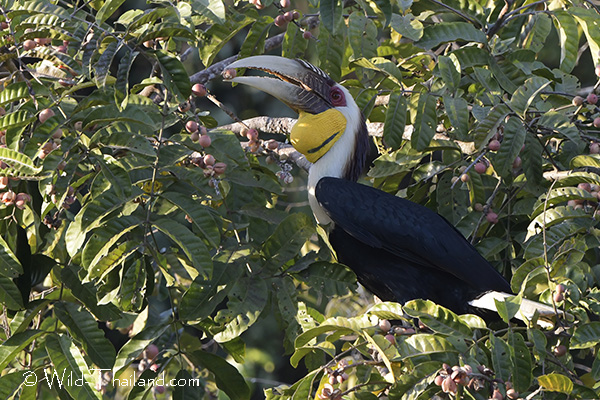
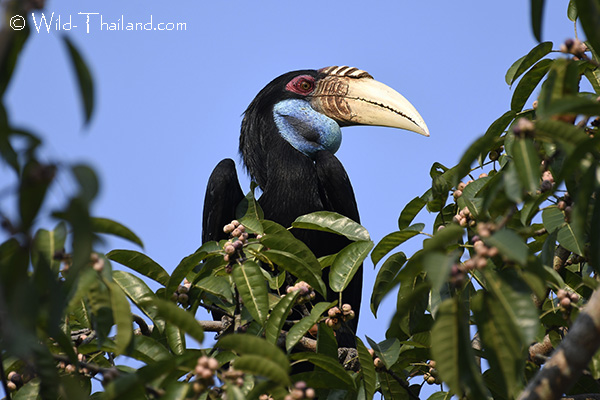
The Wreathed Hornbill is a large black bird with a long, dull white bill and a distinctive casque on its upper mandible. Males are distinguished by a creamy or white head, a reddish nape, and a bright yellow throat pouch with a black band, while females have a uniformly black head and neck with a blue throat pouch. Both sexes have white tails, reddish skin around their eyes, and a black band across the throat pouch.
Distribution
Wreathed Hornbills are found throughout Thailand, particularly in the southern parts of the country and in large forest reserves. They require tropical evergreen forests and have been found at elevations up to 2,560 m.
They can be seen feeding in fig trees.
The breeding season is typically from January to June. After choosing a suitable cavity high in a tree, the female will enter the cavity and, she and the male work together to seal the nest entrance with a plaster-like material made from mud, droppings, and fruit pulp. Leaving narrow vertical slit for the male to pass food through.